scVelo (Bergen et al., Nat Biotechnol 2020)
Bergen, Lange, Peidli, Wolf & Theis. Nature Biotechnology 38:1408–1414 (2020). Helmholtz Munich / TUM (FabianTheis lab). The paper that introduced the dynamical model and gene-shared latent time — the step velocity-skepticism contests.
Summary
scVelo generalizes RNA velocity beyond the steady-state assumptions of velocyto by solving the full gene-wise splicing kinetics (induction, repression, and both steady states) with a likelihood-based EM procedure, inferring gene-specific rates α(on/off), β, γ plus cell-specific latent variables (transcriptional state k_i, continuous time t_i). It couples the gene-wise times into a universal, gene-shared latent time — “the cell’s internal clock” — that it argues is better than similarity-based pseudotime because it is grounded in transcriptional dynamics and “accounts for speed and direction.” For this wiki the decisive detail is scVelo’s own admission of the scale degeneracy: absolute kinetic rates are identifiable only if the overall developmental timescale is supplied as a prior — exactly the physical-time-grounding gap, stated by the method itself.
Key Claims
- Dynamical model. du/dt = α^(k)(t) − βu; ds/dt = βu − γs, solved explicitly over induction /repression/steady-state segments via EM (vs the steady-state model’s linear regression on assumed steady states). Recovers transient populations that never reach steady state.
- Latent time = internal clock. Gene-wise latent times are coupled to a universal gene-shared latent time proxying the cell’s position in the process; on simulations it “reconstructs the underlying real time at near-perfect correlation and correct scale” and outperforms diffusion pseudotime.
- Explicit scale degeneracy (the key line). “Employing the overall time scale of the developmental process as prior information, the absolute values of kinetic rates can eventually be identified.” → absolute rates are not identifiable from snapshot data alone; latent time defaults to a normalized [0,1] ordering. This is the wiki’s thesis, admitted.
- Driver genes by likelihood. Genes with high goodness-of-fit to their phase trajectory are flagged as putative drivers (a dynamics-based alternative to differential expression).
- Variants + speed. Steady-state, dynamical, and a stochastic (moment-equation) model; ~10× faster than velocyto; scales to ~300k cells (stochastic, closed-form).
- Foresaw the anchors. Discussion explicitly anticipates metabolic labeling (SLAM-seq), experimental time, and spatial coordinates as ways to extend latent time and identify absolute rates — i.e. the authors knew the snapshot version is scale-relative.
Physical-time grounding (standing lens)
- Latent time — ordinal or metric? Ordinal in practice (normalized [0,1]); a dynamics-grounded ordering that beats pseudotime (e.g. on pancreas it correctly orders α-cells before β-cells where pseudotime fails, Fig 3d). Metric only if the overall developmental timescale is given as prior.
- Rate–time scale degeneracy. Inherited and explicitly acknowledged — the paper states absolute rates need an external overall-timescale prior. This is the cleanest in-method admission of the degeneracy in the wiki.
- External time anchor. None by default (snapshot-only); the paper anticipates labeling / experimental time / spatial as extensions but does not use them.
- Constant-rate assumptions. α is piecewise-constant (two values, on/off) — the “constant α” JianhuaXing criticizes; β, γ gene-specific constants. Discussion lists this as a limitation, extensible to state-dependent rates.
The honest reading (for regvelo-physical-time-critique and FlowVelo): scVelo did not hide the scale problem — it named it and pointed at the external-prior fix. The “concept-swap” (xing-hu-regvelo-debate) is better stated as: latent time became the de facto time axis in downstream usage even though the paper framed it as relative-without-a-prior. Cite scVelo’s own Supplementary-Fig-3 admission rather than implying it overclaimed.
Figure
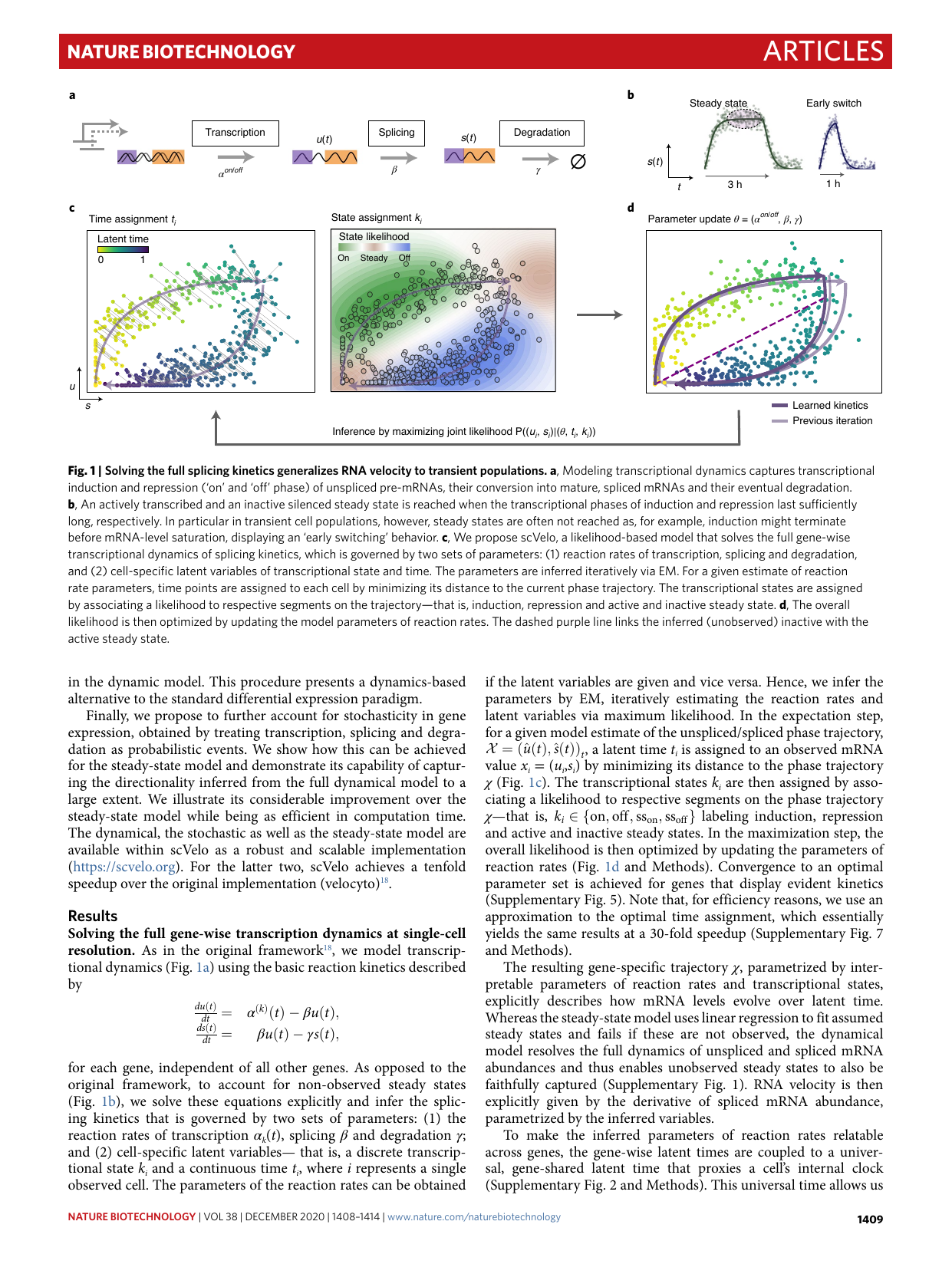
Fig 1 — dynamical model (Bergen et al., Nat Biotechnol 2020; scvelo-2020). (a) Full kinetics with on/off transcription α, splicing β, degradation γ. (b) Transient “early switch” states that never reach steady state — the case the steady-state model mishandles. (c) EM latent variables: continuous time assignment t_i and discrete state assignment k_i (on / off / steady) on the u–s phase trajectory. (d) Parameter update maximizing the joint likelihood P((u,s)|θ,t,k). The gene-wise latent times are then coupled into the universal gene-shared latent time.
Key Quotes
“the inferred latent time represents the cell’s internal clock … In contrast to existing similarity-based pseudo-time methods, this latent time is grounded only on transcriptional dynamics and accounts for speed and direction of motion.”
“Employing the overall time scale of the developmental process as prior information, the absolute values of kinetic rates can eventually be identified.” — the scale-degeneracy admission.
Connections
- scVelo — the method this source defines (entity).
- velocyto — the steady-state predecessor it generalizes (and whose physical-time anchor it dropped).
- latent-time — the concept introduced here in its modern form.
- splicing-kinetics-ode — solved in full (induction+repression) here.
- veloVI / RegVelo / VeloVAE — deep-generative successors.
- physical-time-grounding / velocity-skepticism — the gap scVelo names.
- FabianTheis — senior author (same lineage as RegVelo).
- metabolic-labeling — the anchor scVelo anticipates but doesn’t use.
- FlowVelo — targets the temporal axis scVelo left relative.
Contradictions
- Nuances xing-hu-regvelo-debate. Xing frames scVelo as a covert “concept-swap”; the paper actually states that absolute rates need an external timescale prior. No factual contradiction with wiki pages — it sharpens the critique into “latent time became the de facto time axis,” which is fairer than “they hid it.”