RegVelo
中文導讀
RegVelo(Theis & Sauka-Spengler labs,Cell 2026)是把 veloVI 的 deep-generative velocity 接上 prior GRN 的方法:transcription rate α 不再是 constant,而是由 regulators 經一個 neural net 預測(α_g = h(|Ws+b|_g)),所以 splicing kinetics 跟 regulatory wiring 一起在一個 high-dimensional coupled ODE 裡 fit。它最大的賣點是 mechanistic——接 CellRank 做 in silico regulon perturbation、預測 lineage driver, 還用 CRISPR KO / Perturb-seq 驗證。但對本 wiki 的 physical-time 軸來說:latent time 還是 ordinal(FUCCI Spearman 0.68),β、γ 還是 constant,沒吃任何 absolute-time anchor—— mechanistically grounded, temporally ungrounded。
What it is
A Bayesian deep-generative RNA-velocity model that couples splicing kinetics to a gene regulatory network. Developed by the Theis lab (Helmholtz Munich) and the Sauka-Spengler lab (Oxford/Stowers). It is the GRN-informed successor to veloVI, and is the principal point of comparison for FlowVelo’s mechanistic axis.
Model
Per-gene splicing ODE, but coupled genome-wide through transcription:
du_g/dt = α_g(t) − β_g · u_g(t)
ds_g/dt = β_g · u_g(t) − γ_g · s_g(t)
α_g    = h( |W·s + b|_g )            # transcription predicted from regulators
- W — learnable GRN weight matrix (positive = activation, negative = repression, zero = no edge), constrained toward a prior GRN by penalty λ₁ and sparsified by λ₂ (sparse prior / Jacobian-L1).
- h — nonlinear activation (neural net).
- α — cell- and gene-specific, regulation-driven (the key relaxation).
- β, γ — gene-specific constants (splicing, degradation). Not freed.
- One high-dimensional coupled ODE solved numerically (no closed form), vs the decoupled one-gene analytic ODEs of scVelo/veloVI.
- Encoder→decoder produces cell representations and a cell-gene-specific latent time; stochastic variational inference fits all kinetic + network parameters and yields posterior velocity distributions (intrinsic vs extrinsic uncertainty).
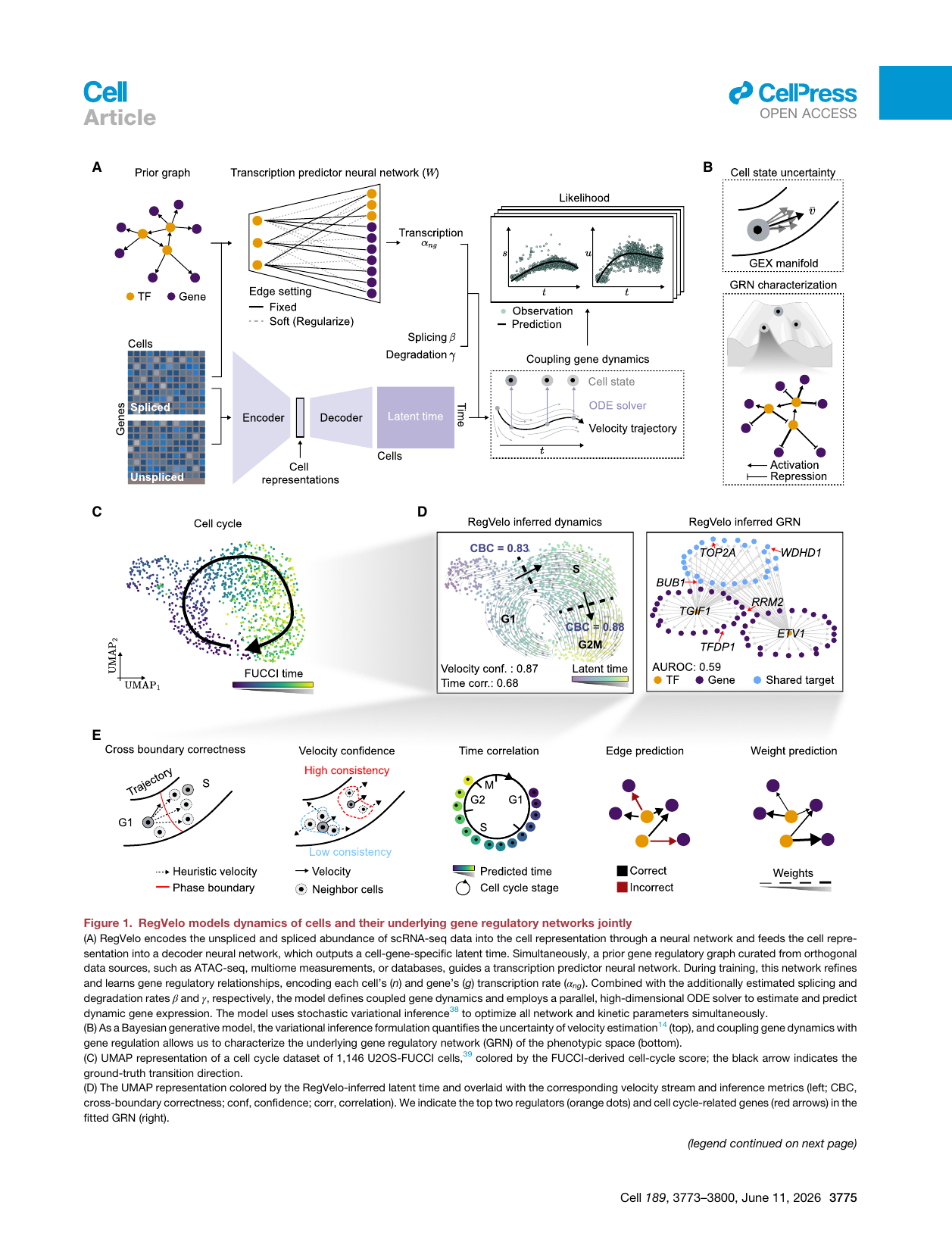
Fig 1 — RegVelo model (Wang et al., Cell 2026; regvelo). The prior GRN graph feeds a transcription-predictor neural network W that outputs a cell-gene-specific transcription rate α; combined with learned splicing β and degradation γ, the genes are coupled in a single ODE solved over a decoder-produced latent time, all fit by stochastic variational inference (A). On the U2OS-FUCCI cell cycle (C–D) the inferred velocity stream scores CBC 0.83/0.88 with latent-time correlation 0.68 to the FUCCI score and an inferred GRN (AUROC 0.59). Panel E defines the five evaluation metrics (cross-boundary correctness, velocity confidence, time correlation, edge/weight prediction) — note the time check is an ordinal rank correlation.
Capabilities
- In silico perturbation — mask a regulon, re-solve, measure cosine dissimilarity (“perturbation effect score”) and CellRank “depletion likelihood” (0–1) to rank lineage drivers causally.
- Terminal states / fate probabilities via CellRank 2 (
PseudotimeKernel, macrostates, TSI). - GRN inference with per-edge uncertainty; recovers known motifs (SPI1–GATA1).
- Model selection —
ModelComparisonpicks the variant best agreeing with known stages/transitions (Jacobian-regularized “Soft-r” wins).
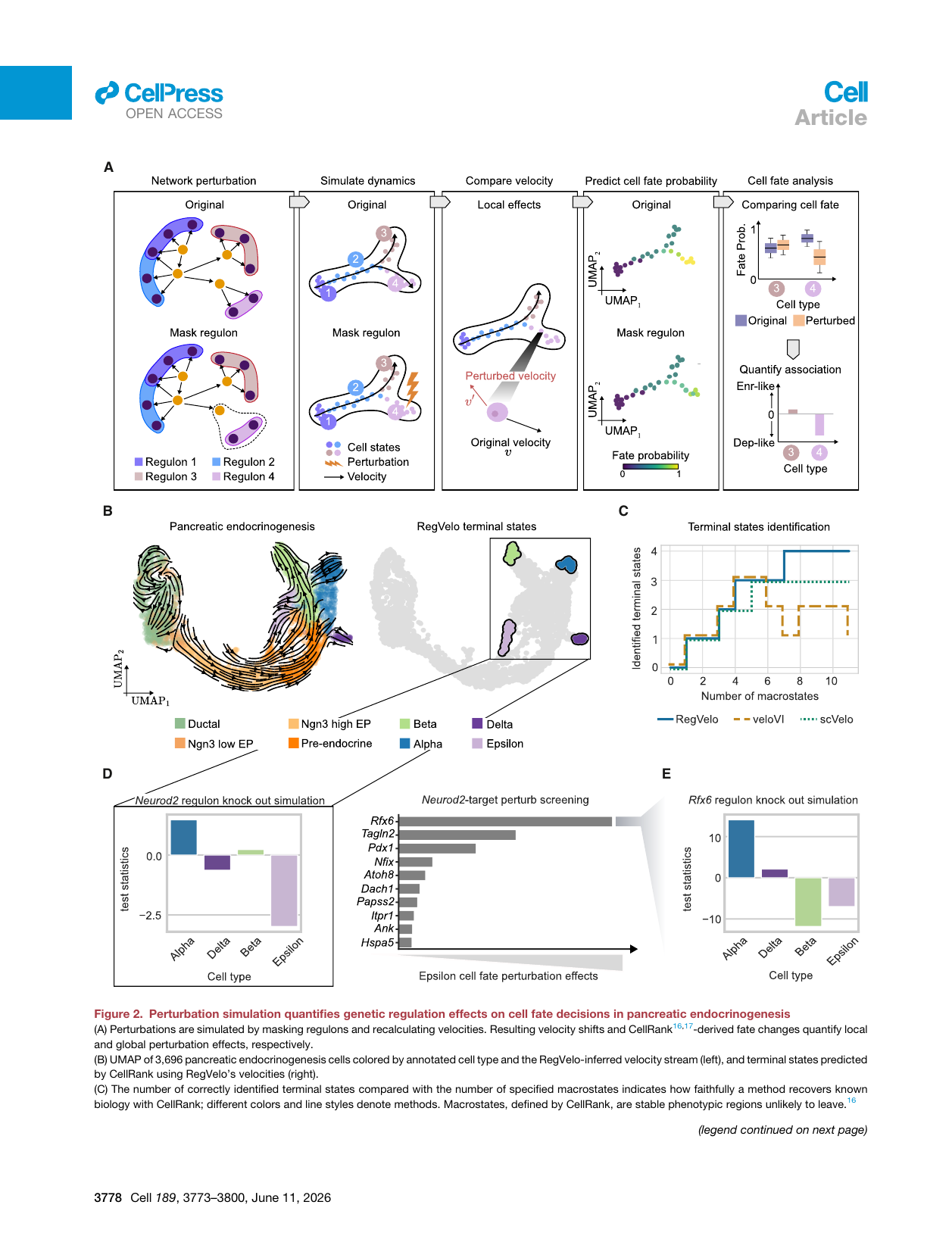
Fig 2 — in silico perturbation (Wang et al., Cell 2026; regvelo). The perturbation pipeline (A): mask a regulon → re-simulate dynamics → compare velocity (local “perturbation effect score” by cosine dissimilarity) → recompute CellRank fate probabilities → quantify enrichment/depletion per cell type. On pancreatic endocrinogenesis (B–C) RegVelo recovers all four terminal states; Neurod2 (D) and Rfx6 (E) regulon-knockout simulations shift alpha/delta/beta/epsilon fate, predicting lineage drivers causally — the mechanistic payoff of the GRN coupling.
Physical-time scorecard
| Axis | RegVelo |
|---|---|
| Latent time | ordinal; FUCCI Spearman ≈ 0.68 (rank check only) |
| Rate scale | α regulation-dependent; β, γ relative constants |
| External anchor | none (snapshot-only; forgoes metabolic-labeling) |
| Verdict | mechanistically grounded, temporally ungrounded |
See physical-time-grounding scorecard and the full regvelo-physical-time-critique.
Validated on
Simulated GRNs (dyngen), U2OS/RPE1 cell cycle (FUCCI), pancreatic endocrinogenesis, human hematopoiesis (5 lineages), embryonic myogenesis, hindbrain, and zebrafish neural crest (Smart-seq3 + 10x multiome + in vivo CRISPR-Cas9 KO + direct-capture Perturb-seq). Headline biology: tfec (early pigment driver) and elf1 (pigment-fate regulator).
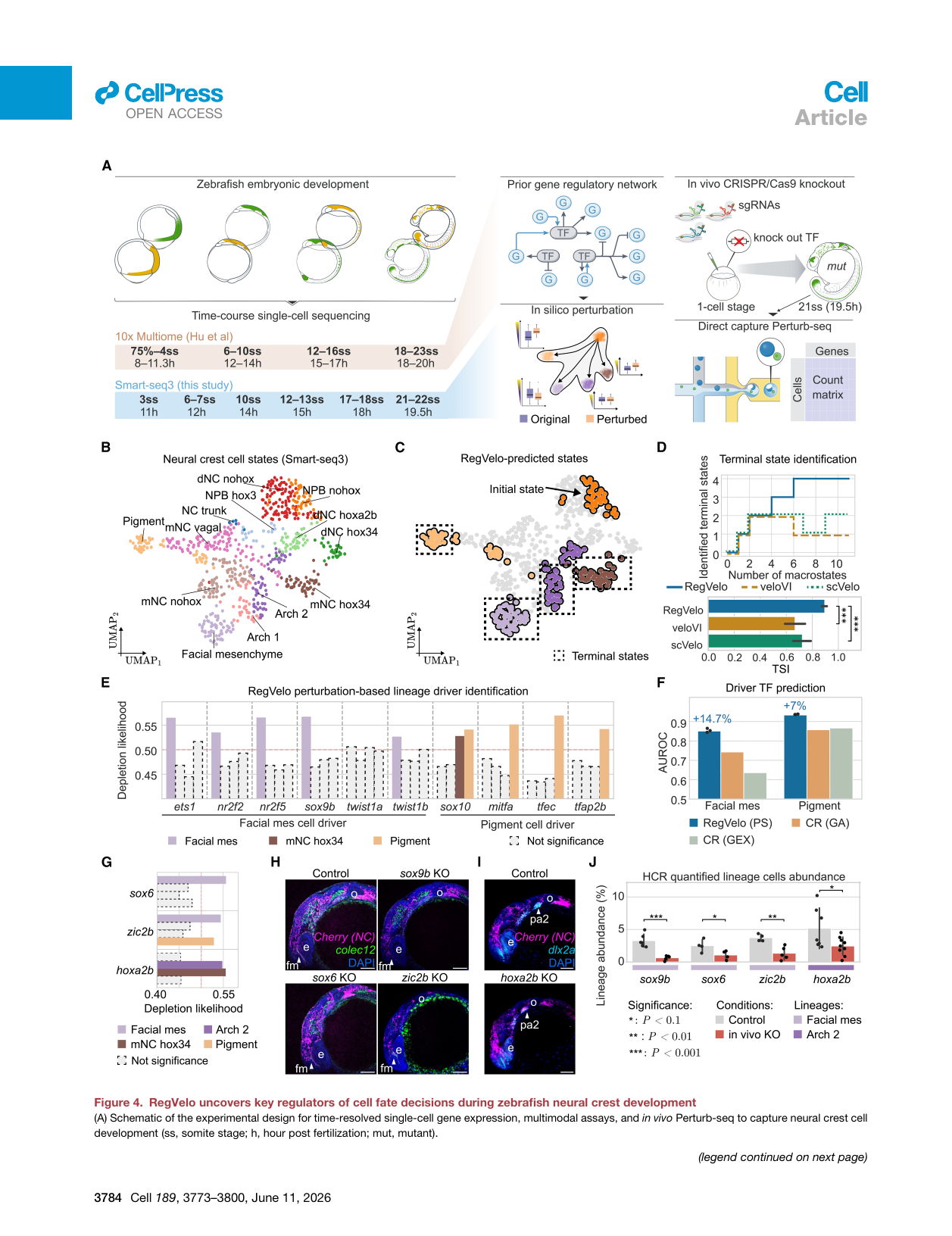
Fig 4 — zebrafish neural crest (Wang et al., Cell 2026; regvelo). Experimental design (A): time-course Smart-seq3 + 10x multiome with a prior GRN, in silico perturbation, and in vivo CRISPR-Cas9 KO / direct-capture Perturb-seq. RegVelo predicts the neural-crest terminal states (B–D) and, via perturbation-based lineage-driver identification (E–F), ranks tfec, mitfa, sox9b, sox6, zic2b, hoxa2b as drivers; HCR-FISH confocal (H–J) confirms lineage depletion after each KO. This is the validated-mechanism evidence — orthogonal to the temporal axis the wiki tracks.
Relation to other methods
- Generalizes veloVI (adds the GRN coupling).
- Argues against the constant-rate assumption of scVelo.
- Out-predicts dynamo on lineage drivers without dynamo’s metabolic labels.
- Plugs into CellRank for downstream fate analysis.
- Contrast for FlowVelo / JuloVelo: RegVelo owns the regulatory axis; the temporal/physical-time axis is open.
External reception
- Announcement: senior author FabianTheis framed it as unifying RNA velocity + GRNs for better OOD perturbation prediction (velocity-discourse-2025-2026).
- Critique: JianhuaXing argues RegVelo does not advance past the dynamo framework — it solves only the (self-inflicted) gene-regulation problem dynamo already addressed, not the latent-vs-physical-time problem (xing-hu-regvelo-debate). In that thread HuYizhou — a 2018-origin contributor, not RegVelo’s co-first author Zhiyuan Hu — gives a pragmatic counterpoint. Keep this measured in the manuscript (see regvelo-physical-time-critique).
Related
veloVI · scVelo · dynamo · CellRank · grn-informed-velocity · splicing-kinetics-ode · latent-time · physical-time-grounding · metabolic-labeling · regvelo-physical-time-critique · JianhuaXing · HuYizhou · FabianTheis · FlowVelo