Potential landscape
中文導讀
Potential landscape 就是 Waddington 那張「山谷分化圖」的數學版:把 cell-state dynamics 寫成一個 scalar potential U 的 gradient flow(v = −∇U)。低 potential = 分化終點 valley,高 potential = 未分化山頂。ddHodge 第一次用真實 embryogenesis data 證明 development 主要就是 gradient 系統 (~88% gradient),所以 potential 可以當 pseudotime;而且用 divergence 量 stability / differentiation potency(負散度 = canalization 收斂、穩定)。注意:這只在 gradient-dominated 區成立,cyclic(cell cycle)區 potential 失效——這是 honest caveat。
Definition
A scalar function U over cell-state space whose negative gradient generates the dynamics: v = −∇U. Cells flow “downhill”; valleys are stable differentiated states, ridges/peaks are unstable/undifferentiated. This is the formal version of Waddington’s epigenetic landscape.
Only gradient (curl-free) systems are fully determined by a potential. Real dynamics generally have a rotational part too (see hodge-decomposition) — so a potential is a faithful summary only when the gradient component dominates.
ddHodge’s empirical result
ddHodge reconstructs the potential from RNA-velocity data and shows mouse embryogenesis is ~88% gradient / ~12% rotational — i.e. development really is a potential-landscape (gradient) system, validated with real data for the first time. Two derived quantities:
- Potential → pseudotime. The potential orders cell states (latent-time); correlates with developmental stage. Conditional: fails where rotational flow dominates (FUCCI cell cycle, ~49% rotational).
- Divergence → differentiation potency / stability. Negative divergence = convergence (canalization, stable, low potency); positive = divergence (plastic, high potency). Embryo cells go from positive (E6.5–7.5, plastic) to negative (E8.5–9.5, canalized) as development proceeds.
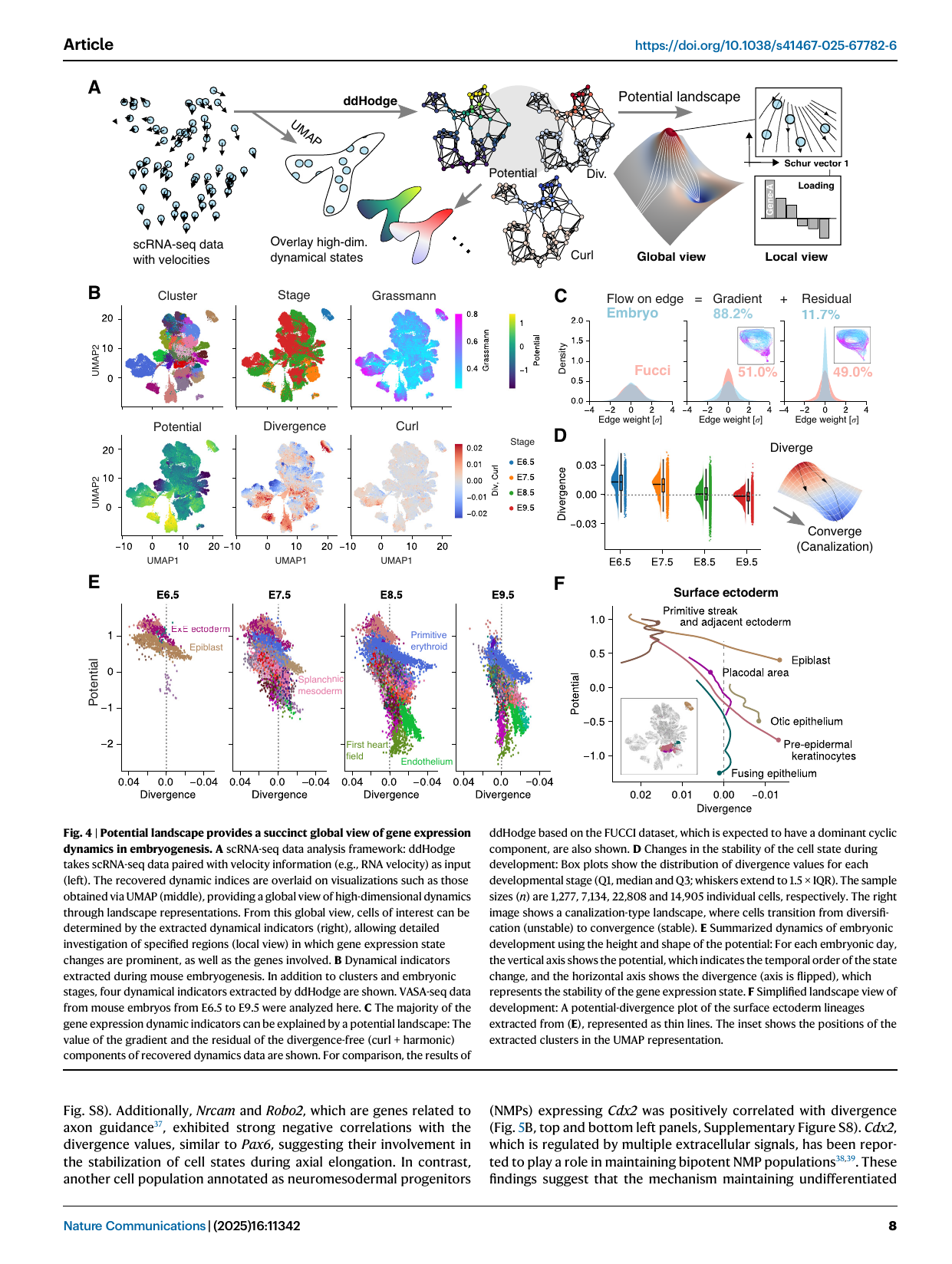
Fig 4 — potential landscape of mouse embryogenesis (Maehara & Ohkawa, Nat Commun 2025; ddhodge). VASA-seq velocity (E6.5–9.5) is decomposed by ddHodge: per-edge flow is 88.2% gradient / 11.7% rotational in the embryo (C) — versus ~51%/49% for the cyclic FUCCI control — confirming development is mostly a gradient (potential-landscape) system. Divergence shifts from positive (E6.5–7.5, plastic/high potency) to negative (E8.5–9.5, canalized) (D), and the potential-vs-divergence plots (E) and the surface-ectoderm lineage (F) read out ordering and stability jointly. The potential gives ordinal time, faithful only where the gradient dominates.
Relation to physical time and to FlowVelo
The potential landscape gives a principled ordering and a potency axis, and (via the slope/curvature) exposes acceleration/deceleration — richer temporal structure than a bare ordering. But it is still ordinal and scale-inheriting: a potential fixes neither absolute durations nor the rate scale (see physical-time-grounding). The landscape framing is directly relevant to FlowVelo / optimal-transport, where a learned potential / transport could in principle carry calibrated time if an anchor is supplied.
Related
ddHodge · hodge-decomposition · latent-time · physical-time-grounding · RNA velocity · optimal-transport · FlowVelo