GraphVelo
中文導讀
GraphVelo(Xing lab,Nat Commun 2025)是一個 velocity post-processing plugin:吃任何 方法(scVelo/dynamo/veloVI)算出的 velocity,把它投影到 data manifold 的 tangent space (manifold-consistent-velocity)。跟 La Manno 的 cosine kernel 不同——cosine kernel 方向對 但 magnitude 丟掉了,GraphVelo 把 方向跟大小一起保留,所以 velocity norm 可以當 cell speed 用。它還能把 velocity 在不同 representation / modality 間 transform(chromatin、spatial、 host–virus)。對 physical time:它本身不 infer time、不 anchor absolute scale(scale 是從 input 繼承的),但它做了兩件相關的事——保留 relative magnitude、而且 放寬 constant-rate(對 MURK genes recover cell-context-specific α、γ)。
What it is
A graph-based, dynamical-systems refinement layer for RNA velocity. It does not estimate velocity from scratch; it takes an existing velocity field as input and makes it manifold-consistent, while extending it to non-transcriptomic modalities. Built by the Xing lab (Pitt / Zhejiang) with Bahar.
Mechanism
- Tangent-space projection (TSP). A cell’s true velocity must lie in the tangent
space T_pM of the data manifold. GraphVelo forms local basis vectors from kNN
neighbor displacements and projects input velocity onto T_pM by minimizing
L(φ) = a·‖v∥ − v‖² − b·cos(φ, φ^corr) + λ‖φ‖²(magnitude term + direction term + regularizer). Preserves both magnitude and direction. - Velocity transformation. Local linear embedding maps velocity between representations (gene/PCA/chromatin/spatial) — Whitney embedding theorem.
- MacK genes (Manifold-consistent Kinetics): genes whose velocity sign matches the manifold direction; whole-genome velocity inferred from the high-confidence subset.
- Rate relaxation: recovers cell-context-specific α, γ for MURK (multiple-rate kinetics) genes, fixing constant-rate errors of scVelo.
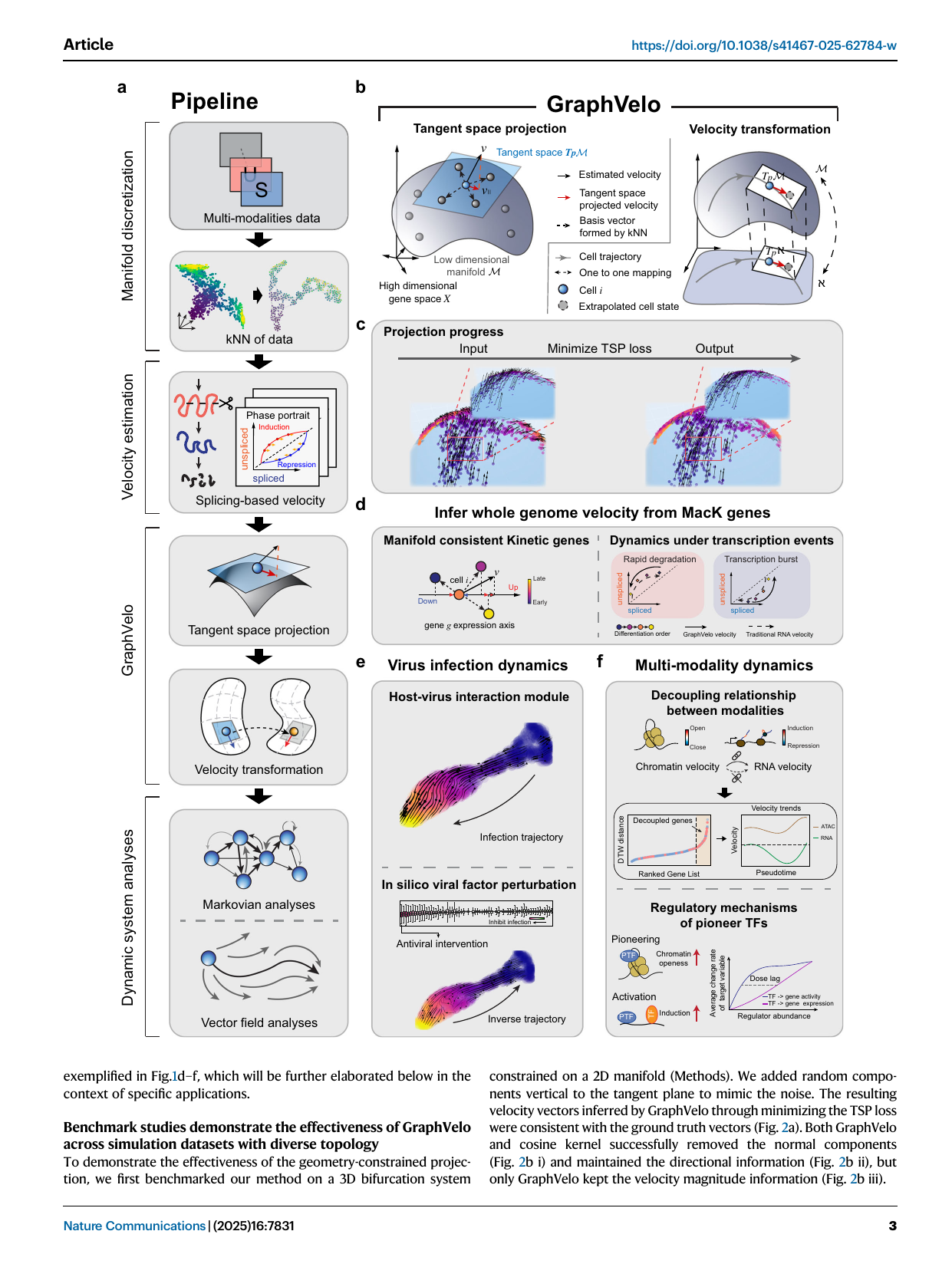
Fig 1 — pipeline (Chen et al., Nat Commun 2025; graphvelo). The plugin sits downstream of velocity estimation: kNN manifold discretization → splicing-based velocity → tangent-space projection onto T_pM → velocity transformation across representations → dynamic-system analyses (a). Panel b contrasts the two operations: TSP constrains velocity to the tangent space while keeping magnitude (the cosine kernel would discard it), and velocity transformation maps the field between manifolds. MacK genes (d) drive whole-genome velocity; e–f show the virus and multi-omics extensions.
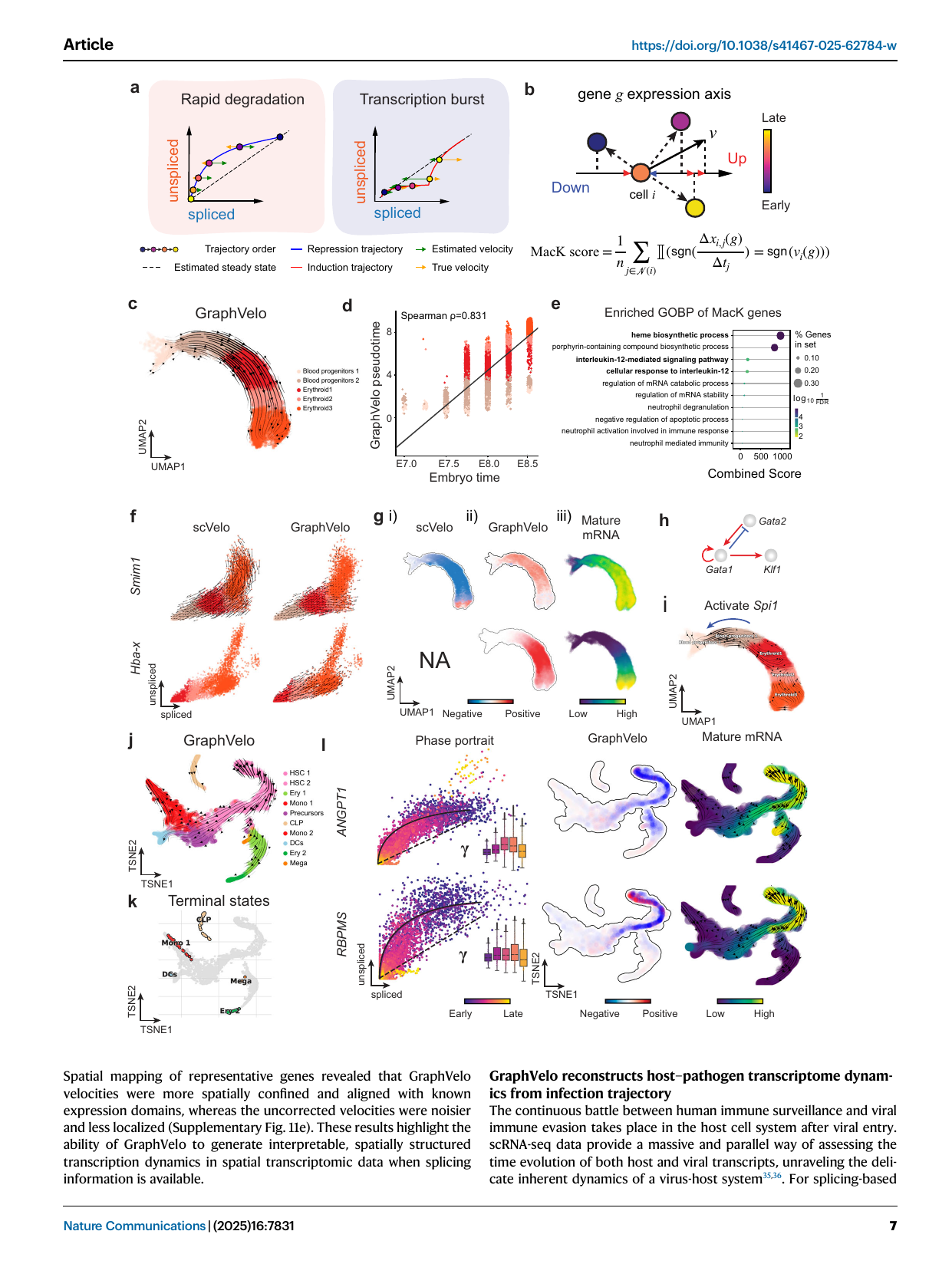
Fig 3 — MURK genes / rate relaxation (Chen et al., Nat Commun 2025; graphvelo). (a) Phase portraits of rapid-degradation and transcription-burst (MURK) genes where the constant-rate steady-state line is mis-estimated; (b) the MacK score = fraction of neighbors whose velocity sign matches the manifold direction. (c–e) GraphVelo erythroid field with pseudotime ρ = 0.831 vs embryo time and GOBP of MacK genes. (f–i) For Smim1 and Hba-x, scVelo infers the wrong velocity sign while GraphVelo matches the mature-mRNA gradient; (j–l) hematopoiesis ANGPT1/RBPMS with recovered cell-context-specific γ — the evidence that GraphVelo relaxes constant rates.
Physical-time scorecard
| Axis | GraphVelo |
|---|---|
| Latent time | refines velocity, not time; downstream pseudotime ordinal (ρ≈0.83 vs embryo time) |
| Rate scale | magnitude preserved (cell speed), but inherited from input method |
| External anchor | none of its own; validates speed vs metabolic-labeling; can ingest labeled velocity |
| Constant rates | relaxed — cell-context-specific α, γ for MURK genes |
| Verdict | manifold-consistent, scale-preserving but scale-inheriting; rates relaxed |
See physical-time-grounding and manifold-consistent-velocity.
Validated on / applications
dyngen simulations (linear/cyclic/bifurcating), mouse erythroid maturation, human bone-marrow hematopoiesis, FUCCI/A549 cell cycle, host–virus (HCMV, SARS-CoV-2), multi-omics (RNA+ATAC chromatin velocity; hair follicle; pioneer TFs Lef1/Hoxc13→Wnt3), and spatial (mouse coronal hemibrain).
Relation to other methods
- A plugin on top of scVelo, veloVI, dynamo — refines their output.
- Downstream uses dynamo (vector field, Jacobian) and CellRank (terminal states).
- Improves on La Manno’s cosine kernel by keeping magnitude.
- Methodologically adjacent to FlowVelo (manifold / tangent-space framing).
Xing’s framing (author’s positioning)
JianhuaXing (senior author) positions GraphVelo as the mathematically rigorous, minimal fix to scVelo’s steady-state problem that preserves the 2018 biophysical model rather than introducing an ill-defined latent-time: because a low-dim manifold makes system DOF ≪ gene count, the velocities of enough “MacK” genes (where the 2018 model holds) determine the rest — for which the naïve 2018 model would be inaccurate or sign-flipped. Theoretical backbone: dynamical-systems-formulation. See xing-hu-regvelo-debate.
Related
manifold-consistent-velocity · RNA velocity · splicing-kinetics-ode · scVelo · veloVI · dynamo · CellRank · metabolic-labeling · physical-time-grounding · JianhuaXing · dynamical-systems-formulation · velocity-skepticism · FlowVelo